Sell Before Foreclosure in Palm Beach County: Your Options
Florida foreclosures run through the courts, which means an owner in Palm Beach County normally has months rather than weeks, and several alternatives - including a conventional sale, a short sale or a negotiated payoff - remain available until the clerk's auction actually happens.
Watch: Foreclosure alternatives for Palm Beach County homeowners, explained in 90 seconds.
Falling behind on a mortgage is one of the most stressful experiences a homeowner can face. The mail gets harder to open, the phone calls start, and the language in the letters gets more formal. What most homeowners in Palm Beach County do not realize is how many options still exist — and how much those options shrink the longer they wait.
PBP Real Estate has worked with distressed South Florida homeowners since the last housing downturn. Broker Gia Freer and the PBP team handled short sales, lender negotiations, and pre-foreclosure listings through the years when Palm Beach County had some of the highest concentrations of distressed inventory in the country. That experience matters, because the process is procedural: the lender follows a script, the courts follow a calendar, and homeowners who understand both keep far more control over the outcome.
This guide explains the real estate side of your options. It is not legal or tax advice. Foreclosure involves state law, your specific loan documents, and potential tax consequences, so you should also speak with a Florida real estate attorney and a CPA before making a decision.
How Foreclosure Actually Works in Florida
Florida is a judicial foreclosure state. That means your lender cannot simply take the house — it must file a lawsuit in circuit court, and a judge must enter a judgment before the property can be sold at auction. For homeowners, this is significant: judicial foreclosure takes time, and time is what gives you room to act.
The general sequence looks like this:
Missed payments and default notices. After a missed payment, most servicers begin collection contact quickly. Somewhere in the early months of delinquency, you will typically receive a formal breach or acceleration letter demanding the full past-due amount within a stated period.
Lis pendens and complaint. If the default is not cured, the lender files a foreclosure complaint in Palm Beach County circuit court and records a lis pendens against the property. You are served and have a deadline to respond. Ignoring this step is the single most damaging mistake homeowners make, because a default judgment moves the case forward much faster.
Judgment and sale date. If the court enters a final judgment of foreclosure, it sets a sale date. Palm Beach County foreclosure sales are conducted through the Clerk of the Circuit Court's online auction system.
Sale and possible deficiency. After the sale, a certificate of title issues to the winning bidder. If the sale price is less than the amount owed, Florida law allows the lender to pursue a deficiency judgment in certain circumstances, subject to statutory limits.
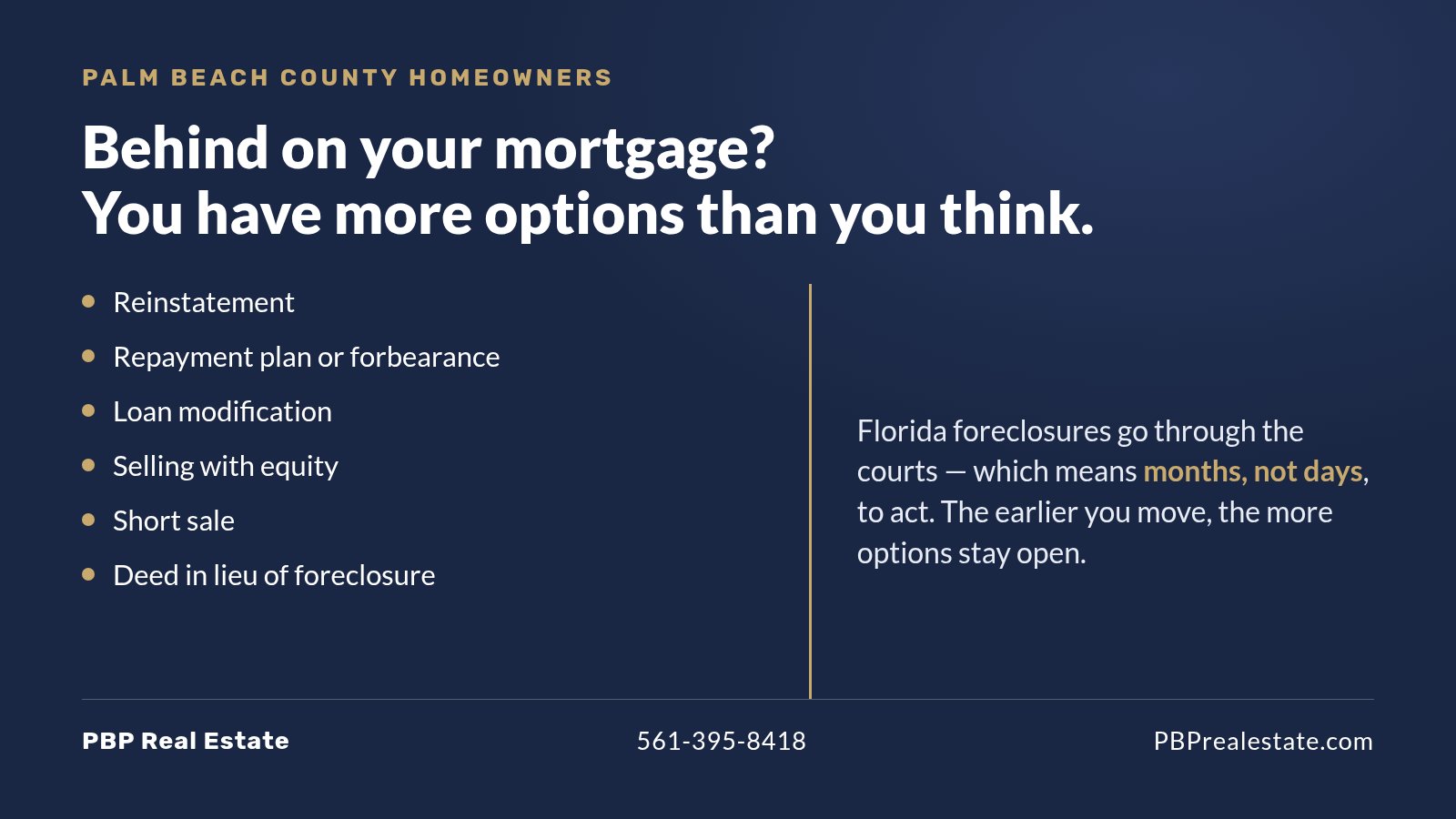
Every case has its own timeline. Court calendars, loss mitigation reviews, and the responsiveness of your servicer all affect how long the process takes. The practical point is this: from the first missed payment to a sale date, most homeowners have a window measured in months — not days — and there are real alternatives available inside that window.
Your Options, From Keeping the Home to Walking Away Cleanly
1. Reinstatement
If your hardship was temporary — a job gap, a medical event, a business slowdown that resolved — the simplest fix is to reinstate the loan by paying the arrears plus fees. Request a written reinstatement quote from your servicer with a good-through date. Amounts change as fees accrue, so never rely on a verbal figure.
2. Repayment plan or forbearance
Servicers can sometimes spread the past-due balance over several months on top of your regular payment, or pause payments temporarily. This works when your income has recovered but you do not have a lump sum available. Get every agreement in writing before you send money.
3. Loan modification
A modification permanently changes your loan terms — interest rate, amortization period, or by moving arrears into a deferred balance — to bring the payment within reach. Modifications require a complete application package: income documentation, a hardship letter, bank statements, and a monthly budget. Incomplete packages are the most common reason files stall. Submit everything at once, keep a copy of every page, and log the date and name of every representative you speak with.
4. Selling with equity
This is the option most homeowners overlook, and in today's Palm Beach County market it is frequently the best one. Many owners who are behind on payments still have meaningful equity, particularly those who bought before the last several years of appreciation. If your home is worth more than the total payoff plus selling costs, you can sell on the open market, pay off the mortgage in full, walk away with the remaining proceeds, and avoid a foreclosure on your credit entirely.
Speed and pricing discipline are everything here. A home listed with an inflated price to "cover everything" sits on the market while the court calendar keeps moving — the exact trap described in our guide to the cost of overpricing a home in Boca Raton. The right approach is an accurate list price, professional marketing, and a broker who understands how to work against a legal deadline.
Start with a realistic opinion of value. PBP provides a free, no-obligation look at what your home is worth and can tell you within a single conversation whether you have equity to work with. Our seller resources explain the full process.
5. Short sale
If you owe more than the property is worth, a short sale allows you to sell with your lender's approval for less than the payoff, with the lender accepting the net proceeds. Short sales require a full lender package — hardship documentation, financials, a listing agreement, and an executed contract — plus patience through the lender's review and valuation process. Our 2026 explainer on what is a short sale covers lender approval, deficiency waivers and the tax rule that expired after 2025.
Two points matter most. First, short sales are approved or denied largely on the quality and completeness of the submission; experienced representation makes a measurable difference. Second, the treatment of any remaining deficiency is negotiable in many cases, and the approval letter language on that point is critical — have your attorney review it before you sign. PBP's short sale and distressed property resource covers the process in detail.
6. Deed in lieu of foreclosure
Here, you voluntarily transfer title to the lender and the lender releases you from the mortgage obligation. It generally requires the property to be free of other liens and a documented, good-faith attempt to sell first. It is usually a last resort, but it can be cleaner and faster than a contested foreclosure.
7. Bankruptcy
Filing can pause a foreclosure through the automatic stay, and Chapter 13 can restructure arrears over time. This is strictly a decision for a qualified bankruptcy attorney — we mention it only so you know it exists as part of the landscape.
Short Sale vs. Foreclosure: What Actually Differs
Homeowners often assume the two outcomes are equivalent. They are not.
Control. In a short sale, you choose the listing agent, you cooperate on showings, and you participate in the negotiation. In a foreclosure, the court and the lender control the timeline.
Credit impact. Both are serious derogatory events, and the effect depends on your overall credit profile and how the account is reported. What differs is the future-financing conversation: lenders' underwriting guidelines have historically treated a completed foreclosure more harshly than a short sale, and waiting periods for a new mortgage differ by loan program. Confirm current requirements with a lender before you assume anything.
Deficiency exposure. In a short sale, the disposition of any remaining balance is part of the negotiation and appears in writing in the approval letter. In a foreclosure, it is governed by the judgment and Florida statute.
Relocation assistance. Some short sale programs — particularly those tied to government-backed loans — have offered seller relocation incentives. Whether a program applies depends on your loan type and investor. Ask; do not assume.
Occupancy and condition. A cooperative short sale lets you stay in the home, maintain it, and move on your own schedule. A foreclosure sale ends with a certificate of title and an eviction process.
Special Situations We See in Palm Beach County
Inherited property with a mortgage in default. This is common. An heir discovers the estate's home is behind on payments while probate is still pending. The estate's authority to sell, the timing of letters of administration, and communication with the servicer all have to be coordinated. Gia Freer specializes in exactly this intersection — see our South Florida probate resource for how estate sales work on the real estate side.
Condo and HOA arrears. In many Palm Beach County communities, unpaid HOA or condo assessments accrue alongside the mortgage default and can trigger a separate association foreclosure action. Association liens have to be reconciled at closing, and estoppel figures often surprise sellers. Address them early.
Insurance and post-storm damage. Homes with open claims, damaged roofs, or lapsed windstorm coverage complicate any sale. Lenders may force-place insurance and add the cost to your balance. If you have an open claim, tell your broker before listing — it changes the strategy.
Vacant homes. Vacancy increases risk of vandalism, water intrusion, and code violations, and most standard policies limit coverage on vacant properties. If you have already moved out, secure the property and confirm your coverage in writing.
Avoiding Foreclosure Rescue Scams
Distressed homeowners attract predators, and South Florida has seen plenty of them. Warning signs: a demand for upfront fees in exchange for a promised loan modification, instructions to stop communicating with your servicer, a request to sign over your deed "temporarily," a guaranteed outcome, or pressure to sign documents you have not read. Legitimate professionals do not need any of those tactics. HUD-approved housing counseling agencies provide free guidance, and a licensed Florida real estate attorney can review any document you are asked to sign.
Move Early — It Is the Whole Ballgame
The homeowners who come through this best are the ones who act while options still exist. Early in a delinquency, nearly everything on this list is available. After a final judgment and sale date, most of it is gone.
PBP Real Estate will look at your situation honestly and tell you what we see, including when the answer is that you should be talking to an attorney rather than a broker. If you have equity, we will show you what the home should sell for. If you are underwater, we will explain how a short sale would work. Every conversation is confidential and there is no obligation.
Call Gia Freer and the PBP Real Estate team at 561-395-8418 or contact us for a confidential review of your options. We work throughout Boca Raton, Delray Beach, and all of Palm Beach County.
This article covers the real estate side of foreclosure alternatives and is not legal, tax, or financial advice. Consult a licensed Florida attorney and a tax professional about your specific situation.
Frequently Asked Questions
How long does foreclosure take in Florida? Florida requires judicial foreclosure, meaning the lender must file a lawsuit and obtain a court judgment before the property can be sold at auction. Timelines vary widely based on court calendars, whether the homeowner responds to the complaint, and whether a loss mitigation review is in process. Most homeowners have a window measured in months rather than days, which is why acting early preserves the most options.
Can I sell my house if I am already in foreclosure in Palm Beach County? Yes. You can sell at any point before the foreclosure sale is completed and a certificate of title issues. If the sale proceeds cover the full payoff plus closing costs, you keep the remaining equity and avoid a completed foreclosure. If you owe more than the home is worth, the sale would proceed as a short sale requiring lender approval. Either way, timing is critical — the court calendar does not pause for a listing.
Is a short sale better than a foreclosure? For most homeowners a short sale offers more control: you choose the agent, participate in the negotiation, stay in the home while it is marketed, and negotiate the treatment of any remaining balance in writing. Both events affect credit, and future mortgage-eligibility waiting periods differ by loan program, so confirm current guidelines with a lender. A Florida attorney and CPA should review the specifics of your case.
Will I owe money after a short sale or foreclosure? Possibly. If the sale does not cover the full loan balance, the difference is called a deficiency. In a short sale, how that deficiency is handled is part of the negotiation and should be stated explicitly in the lender's approval letter. In a foreclosure, it is governed by the court judgment and Florida law. There can also be tax consequences to forgiven debt. Have an attorney and a CPA review any agreement before you sign.
What if I inherited a house that is behind on payments? This happens frequently. The estate generally needs proper authority before it can sell, and the mortgage servicer must be engaged early so the loan does not proceed to foreclosure while probate is pending. Gia Freer specializes in South Florida estate and probate property sales and can coordinate with the estate's attorney to keep the sale and the court process aligned. Call 561-395-8418.
Do I need to keep paying HOA dues while in foreclosure? As long as you hold title, you remain responsible for association assessments, and unpaid amounts can lead to a separate association lien or foreclosure action. Unpaid assessments must also be reconciled at closing in any sale. Ask your association for an estoppel figure early so there are no surprises.
Questions and Answers
How long do I have before a foreclosure auction in Palm Beach County?
Florida foreclosures go through the courts, so the process runs months rather than weeks, and it starts with a summons you generally have 20 calendar days to answer. Until the clerk's auction actually happens you normally still have the right to sell. The practical point is that every option worth having, from a negotiated sale to a short sale, needs time to execute, so the earlier you start the more choices you keep.
Can I sell my house if I am already in foreclosure?
Yes, in most cases. A foreclosure lawsuit does not take away your ownership; it asks the court for permission to sell the property at auction later. Until then you can list and close a normal sale, and the payoff simply comes out of the proceeds. If the loan balance is higher than the sale price, the sale becomes a short sale and the lender has to approve the terms.
Is a short sale better than letting the house go to foreclosure?
Usually yes, but not automatically. A completed short sale is generally viewed more favorably by future lenders than a foreclosure judgment, it ends the monthly bleeding sooner, and it gives you some control over timing. The item to negotiate in writing is the deficiency, meaning whether the lender releases you from the shortfall. This is real estate process information, not legal or tax advice; speak to a Florida attorney and a CPA before choosing.